

Proving it, one Swiss lake plunge at a time
Europe's first Eisbadi, on a frozen lake in Arosa, Switzerland, pairs guided cold-water plunges with sauna sessions for a few months each winter.
Clad in bathrobes and slippers, my peers and I shuffled along the boardwalk toward the frozen lake. The air temperature sat just above freezing as we stripped down to our swimsuits and stood on the edge, planks icy underfoot and breath clouding in front of us.
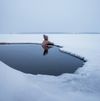
There were only two ways out of this situation. One was to turn around and retreat to the warm sauna, bathrobe belt tucked shamefully between the legs. The other was to climb down the steps into 37-degree Fahrenheit water, its icy crust broken open by someone kind enough to have come out earlier that morning.
This wasn’t a hazing ritual or some forced team-building exercise at a corporate retreat. Indeed, we’d all volunteered to be here. It wasn’t torture. It was wellness.
The setting made a certain sense. Arosa sits at the end of the Schanfigg Valley in eastern Switzerland, at around 5,900 feet above sea level, which makes it one of the highest towns in the country you can still reach by train—the little red Rhaetian Railway cars climb roughly 3,300 feet out of Chur in about an hour, over the Langwieser Viaduct, on what’s often called one of Switzerland’s great rail journeys.
People have been coming here to feel better for a long time. Arosa made its name as a mountain health retreat in the late 1800s, when doctors prescribed the clean, thin alpine air for whatever ailed you. A century and a half later, the cure on offer is cold water rather than mountain air, but the sales pitch hasn’t changed much: come up here, and you’ll leave in better shape than you arrived.
This particular ice-bathing experience was through the Tschuggen Grand Hotel, which takes guests to what it claims is Europe’s first Eisbadi, or ice bath. It takes place at the town’s lower lake, called Untersee—German for “lower lake,” though it functions as the lake’s proper name here, too. The Eisbadi ritual includes a guided lake plunge, followed by a sauna session, repeated two or three times. You can only take a dip a few months of the year, when the rest of the lake is iced over. Fortunately, because the Tschuggen is also a five-star hotel, you finish the experience with champagne and canapés.
The ritual started not with a sauna warm-up but by going straight into the water, and that was easier said than done—especially after watching my companions wade in one at a time to wince, shriek, invoke their deities of choice, and beat a quick retreat back to shore. Some made it only to their thighs, others to their waists, and a few of the bravest among us managed a full, if quick, immersion.
Their short-lived dips weren’t for lack of grit—there were no wimps in this crowd. But as any ice-bathing veteran will tell you, it physically hurts to get into water this cold. For the first few seconds, I felt like I was being stabbed by a thousand tiny frozen needles. Once I was up to my chest, I had to fight down a wave of panic as the cold seemed to squeeze my heart and lungs with its icy blue hand. I heard myself gasp before I’d decided to. My hands and feet tingled painfully, and it was hard to take a full breath. When I got out (I’d like to think I lasted 20 seconds, but I don’t know that I did), my blood vessels screamed in shock, and every patch of skin that had touched the water ached. Robes back on, we all hurried to the Finnish sauna, thick with the smell of hot wood and herbal steam. The heat stung as it hit my numb skin, then softened into something close to relief. I’d never been more thankful for dry heat.
An old ritual suddenly everywhere
Cold plunges, polar plunges, and ice baths alternating with intense heat—none of that is new. These rituals have been around for millennia. Ancient Roman municipal bathhouses, able to serve thousands of bathers at a time, were routinely equipped with heated chambers as well as frigidaria, or cold rooms, housing pools even colder than the one I went in. Farther north, the Vikings treated alternating sauna sweats and freezing fjord dips as basic hygiene, and modern Scandinavians still swear by the combination. In Finland, the sauna-then-cold-water circuit is closer to a national habit than a wellness trend.
What is a recent development is the huge, mainstream popularity of cold-plunge therapy. It’s been picked up by longevity biohackers, by athletes chasing faster recovery, by celebrities (who among us hasn’t seen Chris Hemsworth and his ice-filled troughs on Instagram?), and by the whole wellness-as-lifestyle mindset. Suffering in the cold now keeps hundreds of millions of dollars circulating in the global market in the form of tubs, chillers, retreats, and apps to teach you how to focus while shivering.
But does your circulation actually benefit from that painfully cold dip? Science says maybe. Cold immersion is said to boost the immune system, improve sleep quality and mental acuity, reduce inflammation, and even increase testosterone levels. But research-backed studies of cold therapy come with plenty of qualifiers, and the words can, may, and potentially appear frequently in these study abstracts. However, that ambiguity doesn’t stop die-hard and novice cold-plungers—me included—from giving it a go.
The oldest one in the water

I’m no cold-therapy naysayer, and I wasn’t new to this kind of deliberate discomfort. I’ve jumped into a 48-degree Fahrenheit lake in Iceland, sat in snow grottoes, waded through frigid water-based spa therapies, and lingered longer than most in outdoor unheated plunge pools. Yet wading into this lake hit differently, and it wasn’t just because it was my coldest plunge to date. Maybe it was the cracked sheets of ice stacked like broken glass at the edge of the plunge, the white swaths of snow surrounding us, or the fact that we were out in the open air with the warmth of the sauna a good 100 feet away. But when it was my turn, telling myself “I have to do this” was about more than just the wellness benefits. It was about stepping up for all my Gen X brethren.
My fellow ice bathers on this guided circuit were all a lot younger than me, some by decades. When we went back for round two, bodies still steaming in the freezing air from the sauna, I watched them jump in and immediately pop back out, because the water was just too cold. It was then that I decided I had to outlast them. I was not going to be That Person—the one afraid of slipping, of being uncomfortable, or of suffering through 30 seconds in temperatures colder than the North Atlantic in winter.
I crouched down in the water next to Dominik, our guide for this Eisbadi experience. He’d clearly figured out how to zen out in the water, sitting immersed in a prayer pose, eyes closed. When he told me that the longest he usually stayed in was about a minute, and that anything much longer would put one at risk of hypothermia, I exhaled a frosty cloud of relief. I’d done my 30 seconds and could climb out with my head high and my generation’s dignity intact.
We’d all volunteered to be here. It wasn’t torture. It was wellness.
The part no one admits
I’ll venture that there’s a thing no one says out loud about cold immersion therapy: It’s for people who have something to prove. First, and most respectably, they want to prove to themselves that they can do a hard thing—something that does provide a legitimate mental boost and gives them a chance to overcome the classic mind-over-body conundrum. Then, less nobly, they want to prove it to everyone else—and maybe do it a little better than the next person. Sure, it’s about wellness. But it’s also about getting to say you survived it. That’s probably why so many people post their beaming ice-bath faces on Instagram. It’s a dopamine high with a liberal sprinkling of smugness. But I’d be lying if I said I was above either part of it.
So I’ll cop to a little self-congratulation when Dominik and I turned out to be the last two to leave the ice. But I also felt, physically, really good. Kind of great, even. The cold was still a shock, but on my second round, it read as exhilarating rather than painful. As blood flowed back to my extremities, my skin felt tingly, not stinging. I felt alert and awake in a way that’s hard to come by otherwise. And for a moment, at least, I wasn’t thinking about being the oldest person in the ice hole.
After another session in the sauna, I was ready to hit the ice again. But Dominik signaled that it was time to go, as he had to prepare the sauna for the next group. Too bad, I thought. I was becoming a pro at the hot-cold circuit. Because I’m Gen X, after all. And we’re always ready for another round.

Places to stay
Arosa, Switzerland
Go further with the Expedia app
