
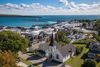
Mackinac Island: The island that banned cars in 1898
A ferry ride from the mainland, Mackinac Island trades engines for hooves and modern life for Victorian hotels, historic forts, and marble-slab fudge.
I heard the place before I saw it — the clop of hooves on the street, bicycle bells, and, once the ferry pulled away, not a single engine. Mackinac (pronounced MACK-in-aw) Island has been a summer retreat in Michigan since the 1860s. Back then, the American Midwestern elite sought it out to escape their blistering hot home cities, traveling by train and then steamship to this cooler destination just east of the Straits of Mackinac, the waterway connecting Lake Michigan and Lake Huron. Locals still call it the “Jewel of the Great Lakes.”
Getting there today, whether for a day trip or a long weekend, is more than a crossing between Michigan’s Upper and Lower peninsulas. It’s a trip back to the island’s 19th-century heyday as a resort — one that never really ended, since Mackinac still collects tourism accolades today.
The island is a time capsule of a grand Victorian-era hotel, 18th-century forts, and old-fashioned fudge shops along its vintage main street — but its most nostalgic sights are the horse-drawn carriages. Aside from bicycles, they’re the island’s only public transportation, and not for show: the ban on motor vehicles started in 1898 and has held ever since. M-185, the 8.2-mile road looping the island, is currently the only state highway in the U.S. where cars are prohibited.
A sacred place for Anishinaabek People
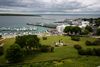
The name Mackinac Island comes from the Indigenous word Michilimackinac, loosely translating to “Place of the Great Turtle” -- the shape early Anishinaabek people saw in the island’s topography. French fur traders adapted this to Michilimackinac (replacing the sound of the “c“ at the end with an ”aw“ sound). Later, the English later shortened it to Mackinac.
Anishinaabek is an umbrella term that covers three distinct but related nations: the Odawa (Ottawa), Ojibwe (Chippewa), and Potawatomi, together known as the Council of Three Fires (Niswi-mishkodewinan). Archaeological evidence of their presence indicates this has been their ancestral home since at least CE 900, though oral traditions go even further back. Today, the island is still considered a spiritual and creation center to living descendant communities, like the Sault Ste. Marie Tribe of Chippewa Indians and Little Traverse Bay Bands of Odawa Indians.
The Odawa, whose name derives from the words adaawe/odawe, meaning “to trade,” were the region’s premier traders and canoers, serving as middlemen who facilitated the exchange of corn, fish, and fruit between local tribes and Europeans. Without their deep knowledge of the people and geography, trade would likely have been too difficult for Europeans.
Today, one of the oldest buildings on the island is Fort Mackinac. It was built by the French on the mainland in 1715 to secure the fur trade, but it changed hands over the decades in various treaties, at times under the control of Indigenous Americans, American revolutionaries, and the British and French.
During this time, marriages between Indigenous women and French and British traders were common, and some of those treaties were negotiated by Agatha Biddle (1797–1873), of both Odawa and French heritage. She rose to prominence on the island with her fur trader husband, Edward Biddle, becoming a leader in the community and adopting orphaned and sick children. She was chief of the Mackinac band of Ojibwe and Odawa people—a band that was almost entirely headed by women—and played a role in everything from treaty matters to political issues. She was inducted into the Michigan Women’s Hall of Fame in 2018, and her 1780’s home is now the Biddle House, home to the Mackinac Island Native American Museum.
Horses vs. horsepower

While horses have existed on Mackinac Island since the 1780s, it wasn’t until the mid-19th century, when island tourism started to evolve, that they were used to pull carriage tours around. The first carriage license was issued in 1869, and since then horse-drawn carriages have been the island’s main mode of transportation. The exception was a brief stint in the late 19th century, when Michigan’s burgeoning auto industry, based in nearby Lansing and Detroit, started its inevitable introduction of “horseless carriages” around the country, Mackinac Island being no exception.
But public opinion didn’t embrace these loud new machines, considered mostly to be a nuisance and frightening for the island’s equine residents. Their caretakers chose to prioritize animals over machines, successfully petitioning a ban on cars that became law on July 6, 1898. It protected their livelihood and kept the air clear of engine emissions. After more than thirteen decades, the prohibition has never been lifted — not even for UPS or FedEx, which subcontract to horse-and-carriage companies for the final legs of a delivery.
However, there are a few modern exemptions to the ban: electric golf carts are allowed on the island’s three golf courses (though a horse-drawn carriage still brings players between the front and back nine at The Jewel), as are trucks for the local power company and a handful of modern emergency vehicles. The only other time motor vehicles were allowed adds a tick to the Mackinac historical timeline: it was 1979, during the production of the motion picture Somewhere in Time. Ironically, it was a film that used Mackinac Island as a set location of a past where cars didn’t exist.
A love story, on location
Somewhere in Time was released in 1980, starring Christopher Reeve and Jane Seymour in a romance-meets-sci-fi plot in which traveling through time is the only way for the two protagonists to form a love connection. A box-office sleeper at first, it gained cult status over the decades and has drawn many visits to Mackinac Island. There’s so much interest from fans that there’s even an annual Somewhere in Time weekend each October, with events and period costumes. They’re also drawn to the sites seen on screen, like the Round Island Lighthouse, erected in 1895, and the shops of Main Street, many of them former trading posts from the 19th-century fur trade. But the grandest shooting location is famous well beyond the film: the Grand Hotel, widely known as “America’s Summer Palace.”
Sleeping in a landmark

Listed on the National Register of Historic Places, the Victorian-era hotel opened in 1887 with Queen Anne-inspired architecture and touches of the colonial-revival style — think columns and symmetry — across the façade. It has nearly 400 rooms, each uniquely decorated, and what it bills as the world’s longest front porch, measuring 660 feet. You need not be an overnight guest to enjoy the hotel: it’s become such a tourism draw that day passes are available for anyone wanting to walk the interiors of a former era or simply sit in a rocking chair on its gargantuan porch and gaze out at Lake Huron.
The Grand isn’t the only historic property you can reach via horse-drawn carriage from the boat docks. Mission Point Resort has its own unique past: its buildings went up in the 1950s as the campus of a love-and-unity moral-reform movement, briefly became a college in the 1960s, and now houses a 243-room resort. Parts of it, including the theater and a soundstage, were used in the 1979 Somewhere in Time production.
Nearby, secluded on the island’s western bluffs, is the Inn at Stonecliffe. It’s an English Tudor-style mansion built in 1904 as a summer home for a Chicago meatpacking mogul. Reopened in 2024 after a long restoration, it’s a quieter place to stay than Mission Point Resort, accessed via a 2-mile horse-drawn carriage ride offering views of the straits and Mackinac Bridge.
From fur to fudge

Despite wars fought to protect and stake claims on the lucrative North American fur trade, Mackinac Island gradually became less of a trading hub by the mid-19th century, when it began evolving into the summer tourism destination it is today. But that history hasn’t been erased, and a cluster of preserved homes along Main Street still tells the story. The 1780s Biddle House, once the log-constructed residence of fur trader Edward Biddle, now houses an Indigenous American museum. Steps away, the 1790 McGulpin House survives as an artifact of early French-Canadian homes and is open daily in the summer. And the former home of a clerk for the American Fur Company is now the Stuart House City Museum, with exhibits on the island’s military history, Native American culture, and the heritage of local fudge.
Like horse-drawn carriages, fudge making is part of Mackinac Island’s enduring history, dating to 1887, when the Murdick family arrived to sew canvas awnings for the new Grand Hotel and opened a candy store on the side. They made fudge on marble slabs in the storefront window to entice customers, inadvertently spearheading a Mackinac Island fudge industry that has at least a dozen shops today that collectively churn out 10,000 pounds a day at the height of summer.
But unlike melted chocolate, the creation of the industry wasn’t a smooth one. Two world wars and the Great Depression meant a drop in tourists and sugar rationing, leading many of the original fudge purveyors to shutter.
However, things turned around at the dawn of the great American road trip in the 1950s, following President Eisenhower’s expansion of the interstate highway system. It became easier for travelers to reach the island by ferry, allowing them to cross with fudge-consuming intentions —so much so that “Fudgies” became the nickname for tourists to the island, a term still used today. The original Murdick’s shop endures and still makes fudge on marble slabs for spectators, just as it did some 140 years ago. And I was one of them, watching a fudge maker fold a cooling ribbon of chocolate back on itself with a long steel spatula, the smell of warm sugar and butter filling the shop.
No time machine required
Some people travel for beaches, some travel for food. For the history buffs who travel to learn about the past, Mackinac Island will keep being a draw. The whole isle isn’t a throwback to the America of yesteryear; it’s a place where things have simply stayed as they were in the 19th century, in its architecture, its transportation, and parts of its daily life — and no time travel is required to get there.
Places to stay
Mackinac

Go further with the Expedia app
