
When the monarchs of Michoacán take flight
In Michoacán's oyamel forests, naturalist guide Melissa Silva has spent a decade leading travelers into one of nature's great winter migrations — and quietly working to keep it going.
Deep in the oyamel forests of the central Mexican highlands, a petite woman in gray hiking gear raised her hand to halt our tracks. She glanced back, a dark braid swinging over her shoulder, and whispered, “Close your eyes and listen.”
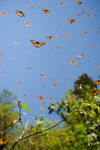
We obeyed. What sounded like the flipping of pages in dozens of miniature books fills the air. I cracked an eye open and saw what at first appeared to be falling leaves. Hundreds of thousands of monarch butterflies glided on air currents and alighted on branches, the forest floor, even our hair and clothes. They formed clusters so dense, they obscured tree trunks and bent branches into graceful arcs.
Leading us into this unreal spectacle was Melissa Silva, a Guadalajara-born naturalist guide who first saw this migration in the 1980s, standing in the same chilly yet still verdant winter mountain landscape beside her mother. “We were mostly alone,” she says. “There was a lot of sun, and the butterflies were flying around. It was magical, like little fairies everywhere.” Four decades later, she’s the one leading strangers into that same magic — and, this particular morning, walking a stretch of shady forest thick with towering oyamel firs and highland oaks that even she hadn’t scouted yet.
A mystery she’s spent a decade explaining
The experience stuck with Silva through undergraduate and graduate work in marine science at the National Technological Institute of Mexico, and guiding whale-watching trips in Puerto Vallarta. When she joined Nat Hab in 2015, she began with “Kingdom of the Monarchs,” the tour on which I met Silva and gained insight into her work.
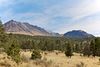
Departing Mexico City, we drove past the snow-tipped Nevado de Toluca volcano and into the former mining town Angangueo. After a 30-minute ride on a rickety pickup truck, we entered El Rosario Butterfly Sanctuary, one of three open-to-the-public conservation areas in Michoacán. All are part of the 129,000-acre UNESCO Monarch Butterfly Biosphere Reserve, which can be visited between mid-November and mid-March.
Silva has discussed the migration hundreds of times, and she still tells it with wonder. Throughout the trip, as we gathered around a communal dinner table or visited an Indigenous cultural center or relaxed in a pool fed by natural hot springs, she explained the science of butterflies. Each autumn, millions of monarchs travel roughly 3,000 miles from the northeastern United States and Canada — a trip needs verification against current entomological consensus — to winter, from November through March, in this stretch of the Trans-Mexican Volcanic Belt, roughly along the 19th parallel, then hand the return trip north to grandchildren they’ll never meet.
How the insects, whose brains are smaller than a grain of rice, find their ancestral resting and breeding grounds year after year remains a scientific mystery, and one of the animal kingdom’s great migration stories.
Silva didn’t discover this migration route. That happened in 1975, when self-taught naturalist Catalina Trail and her husband, Kenneth Brugger, answered a newspaper ad from Canadian zoologists searching for volunteer monarch spotters — and, over two years, used Trail’s knowledge of the language and the land to find the colonies Silva now leads groups into. But Silva sees her own work as an extension of Trail’s, not a footnote to it. “She opened this path for women expedition leaders in Mexico,” Silva says, “and for women in the communities to be part of conservation.”
In 1976, a major publication showcased a multi-page feature about the discovery. Trail was reduced to a single mention as the “bright and delightful Mexican, Cathy.” Soured by the misrepresentation, Trail, who is now remarried and lives in Austin, kept quiet until 2015 — coincidentally, the same year Silva began leading monarch tours for Nat Hab.
The people who make the wonder possible

While taking a load off 10,000 feet above sea level would seem to confer some protection for the pollinators, Silva explained that illegal logging, drought, wildfires, and clear-cutting forest to create avocado plantations have taken a detrimental toll — as has the sharp decline of milkweed, the pollinators’ primary food source, in the United States. Studies have shown that monarch populations have decreased 90 percent over the past 30 years. Although conservation groups have proposed listing them as threatened under the Endangered Species Act, the protections haven’t passed.
In Mexico, conservation movements began gathering steam in the 1990s. Some residents still believe, as did the Purépecha and Mazahua peoples of central Mexico, that the souls of the dead are reborn as monarchs. Today, the butterfly sanctuaries are managed by ejidatarios, communal owners who tend the land, monitor illegal activity, and provide a variety of services – from truck driving to guiding, cooking, and selling souvenirs.
Silva can name the ones she works with, who drives, who cooks, who already knows which slope the colony has drifted to before anyone else does. It’s a relationship she’s built over a decade, and one she talks about with more affection than she does about the butterflies themselves. Nat Hab guides like her bring in tourist-friendly supplies that are hard to source in rural Michoacán — coconut oil, oat milk — and collaborate on everything from park scheduling to horseback transport to meals. “They really put a lot of energy and soul and love into everything they do for us,” she says.
I witnessed this firsthand. On our last morning, Silva leant over the front seat and chatted animatedly with the bus driver. “Estas seguro?” (“Are you sure?”) I heard her say twice, before conferring with her co-leader, naturalist guide Alfonsina Hernandez. Silva turned to us, microphone in hand, and said, “So, my friends, we are not returning to El Rosario this morning.” We groaned in disappointment. She waggled her eyebrows. “Because we have something better for you!”
The butterfly colony had moved to a more remote part of the forest. The trail was longer and steeper than anticipated. “How much farther?” one tour participant groused. “Up there—are you serious?” griped another, pointing at a rocky ascent.
Silva encouraged us along. When we leveled off in a stretch of woods divided by a shallow ravine, she brought her forefinger to her lips and pointed up at the treetops. We fell into an enchanted hush, observing swarms of monarchs circling in the rising sun. For an hour, we watched stained-glass wings soaring through the air and the trees, and delighted in the tickle of miniscule feet as the butterflies came in for a rest along our hands, arms and necks.
Unexpected moments like these are Silva’s favorite part of the job. “In nature, everything has a pattern,” she explains. “‘On a certain type of day with this type of weather, I expect this to happen.’ But nature also has surprises. I’m always excited for days like these.”
Teaching travelers to see themselves in the pattern

Silva is hopeful that the growing interest throughout North America in backyard pollinator gardens and butterfly conservation is paying off. In 2026, the World Wildlife Fund clocked a 64 percent increase in the overwintering monarch population in Mexico, and three fewer acres of forest loss over the year before. It’s still too early to quantify the effect on the generations currently sipping the nectar of asters and coneflowers in the Northeastern United States and Canada, but a groundbreaking new Bluetooth tracking project seeks to answer these and other questions.
Until then, Silva aims to reconnect people with their role in nature. “At the beginning of my guiding career, I remember people thinking a little bit more separate, like, ‘This is happening here in the US, but it doesn’t affect Mexico,’’ she says. “We are all connected, like a net. Whatever you are doing, for good or for bad, is going to have repercussions elsewhere.”
As the sun ducked behind the clouds, the ravine emptied and the butterflies assembled, as if drawn by magnetic force, into grapelike clusters, until the entire grove seemed to fall into a doze. Silva waited until the last of our group had taken their photos, then turned back toward the trail, already deep in conversation with Hernandez about whether this secluded stop would earn a place on next season’s itinerary. She’s led people into these mountains long enough to know the butterflies don’t need an audience. But for as long as she keeps making the climb, neither does she plan to stop bringing one.

Places to stay
Puerto Vallarta
Go further with the Expedia app
