
The long history along New Mexico’s high roads
A 140-mile loop from Las Vegas to Santa Fe to Taos, past a capital founded in 1610 and a pueblo inhabited for more than 1,000 years.
I grew up in a road-trip family that regularly went up and down California and even across the country, so it felt full circle to point my own car from Denver toward New Mexico with three generations inside it. My sister, Ashley, took the passenger seat. My mom, Gail, rode in back with my daughter, Margot, not yet two and already running the itinerary.
We traveled for the drive more than for any one destination. But the deeper into New Mexico we got, the more we saw how the state’s many layers of history are kept alive today. The loop of about 140 miles from Las Vegas to Santa Fe to a mountain village called Chimayó and on to Taos brings centuries of history to the forefront.
Where the trail met the rails
Our first stop, five hours south of Denver, was Las Vegas—the New Mexico one, founded in 1835 about 70 years before the more famous Las Vegas out in Nevada. The drive down I-25 slowly transitions from the Colorado Front Range mountains to the high desert and tree-lined foothills of northern New Mexico. Las Vegas sits on a plateau at more than 6,400 feet elevation, nearly 1,200 feet higher than Denver’s famous mile-high elevation.
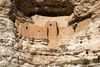
Las Vegas formed in 1835 from a Mexican land grant and became the first major town that people traversing the Santa Fe Trail saw since the start of the trail in Missouri. New Mexico didn’t become a United States territory until 1850. When the railroad arrived in 1879, it boomed into the largest city in the Southwest. Then the boom moved on, and the buildings stayed: more than 900 of them are on the National Register of Historic Places in a town that now has fewer than 13,000 people. The plaza, first laid out in 1835, still has its gazebo and its old trading-post layout, and the storefronts around it now hold galleries and antique shops.
We stayed at the Castañeda, which opened on the first day of 1899 as the first trackside hotel in Fred Harvey’s chain. His hotels, known as Harvey Houses, came to define both accommodations and architecture in the Southwest, and the aesthetic still stands. This particular hotel holds a deep history. Theodore Roosevelt held the first reunion of his Rough Riders here in a raucous 1899 party. It was mostly empty for the better part of the 20th century, however, until preservationist Allan Affeldt and artist Tina Mion bought it and brought it back, reopening in 2019 with Mion’s paintings on the walls inside and the Las Vegas train stop just past the courtyard.
It draws Roosevelt buffs and ghost hunters in about equal measure (it made an appearance in the show Ghost Adventures). The staff doesn’t hide from the paranormal and will eagerly tell you ghost stories of their own if you ask. I’m not a ghost chaser, but I’ve stayed in enough historic hotels to know that I prefer to hear other people’s stories more than I like to experience any of my own.
Up the hill is another railroad relic: Montezuma Castle, a turreted 1880s resort that is now the campus of the only United World College in the United States. On its grounds, the Dwan Light Sanctuary, a white stone rotunda that the art patron Virginia Dwan finished in 1996, is free to walk into if you pick up an access key at the welcome center. Its window prisms are set to line up with the sun, moon, and stars, and they throw a rainbow of color across the walls all day.
A capital older than the country around it
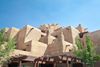
An hour on, Santa Fe is the oldest state capital in the country, laid out around a central plaza in 1610 and governed since under Spain, then Mexico, then the United States. We picked up my wife, Heather, at the airport and spent our first morning on the Plaza, where Pueblo artists sell silver and turquoise under the long portal of the Palace of the Governors. Families have sold in that arcade for generations, and the Palace built the same year the city was founded behind them, is the country’s oldest colonial-era public building still in use. A few steps away, dancers and musicians from the nearby Tesuque Pueblo performed on the Plaza gazebo.
The layers here don’t rest as neatly as the adobe suggests. In 1680 the Pueblo nations drove the Spanish out of New Mexico entirely. Spain reconquered the region 12 years later, but the period reshaped how the colony was run and helped continue Pueblo culture and traditions that can still be seen.
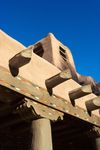
Santa Fe has preserved the look of the Spanish colonial years, and downtown has strict architectural guidelines to maintain the low adobe building style. For history lovers, it gives the feel of a place in a different era than the high-rises and condos that shape the look of most modern state capitals. For artists and anyone who appreciates art, Santa Fe’s aesthetics are a natural draw. Its reputation as a top art destination was bolstered in 2005 when it became the first UNESCO Creative City in the U.S. for its craft and folk art. On Museum Hill, the Museum of International Folk Art holds the largest collection of its kind in the world; its maze of a main gallery can show more than 10,000 pieces at once, and by the end of it, Margot had opinions about most of them.

Food carries as much history as the buildings do. The Santa Fe Farmers’ Market started with six growers in 1968 and now runs to more than 150 farmers and producers from 15 counties across northern New Mexico. Everything on the tables was grown or made by whoever’s selling it. We worked through pupusas and lamb sausage, drank agua fresca, and left with cheese, honey, and bread for the days ahead.
We slept at Piñon Court by La Fonda, a 1930s adobe that opened as a motor court for travelers on Route 66, which ran straight through Santa Fe until a 1937 realignment cut the city loose after just 11 years on the route. The old bones show in the vigas and the kiva fireplace, an easy walk from both the Railyard and the Plaza.
Holy dirt and older faiths
It would be easy to stay and keep exploring Santa Fe’s 20 or so museums and many more galleries. Short drives outside the city lead to places with just as much of a historic and artistic story to tell.
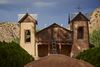
We drove north for 40 minutes to the edge of the High Road to Taos to reach El Santuario de Chimayó. The Tewa, part of the Pueblo who lived in this part of New Mexico long before European arrival, and still do, considered the land sacred and healing ground. The Spanish brought Catholicism and thought the same of the dirt here: the “holy dirt” is believed to cure a variety of body aches, injuries, and ailments. This Catholic place of worship is one of the most visited pilgrimage sites in the country, with an estimated 300,000 travelers a year who come for the dirt. Many walk to the remote site during Holy Week. Built in 1813, the church is very much alive today, with religious services throughout the complex and vendors selling New Mexico’s famous chiles just outside the grounds. Out in the courtyard by the river, Margot joined the other kids laughing and running through history.
The story continued for us with lunch down the road at Rancho de Chimayó, in an old family hacienda strung with chile ristras. The same family has run it since 1965; it won a James Beard America’s Classics award in 2016, and the carne adovada in Chimayó red chile earns the reputation. Get the sopapillas with honey afterward.
The long way home
From Chimayó the road climbs toward Taos on the High Road over about 70 miles of switchbacks and old land-grant villages. Taos is quiet outside of its famous ski season. We poked through the John Dunn House Shops off the plaza and ate breakfast at Manzanita Market, tables full of local guides gearing up for the day.
On the drive back to Denver, my mom entertaining Margot in the back seat, it hit me that we had covered more than 1,000 years of history along a road you can drive in a long weekend. Not that Margot will remember the facts from each stop. Her dolls from Taos will end up in a pile somewhere, and whatever she remembers of the trip will come from photos she sees later. I don’t remember my first road trips either, only that there were a lot of them. None of what we saw in New Mexico seems to be going anywhere, though. It was all in use long before we drove through, and much of it will likely still be in use when Margot is old enough to drive the road herself.
Places to stay
Santa Fe

Go further with the Expedia app
