

The warm holiday glow of Rochefort-en-Terre
Each December, Rochefort-en-Terre wraps its medieval lanes in miles of light and fills the air with the scent of butter, sugar, and mulled wine.
The damp and cold December air makes its way down the back of my collar as I walk from the small parking lot along the path through the woods to the small town of Rochefort-en-Terre. I zip my coat all the way up to my chin and turn to Maïwenn, my 10-year-old niece, to make sure her thick scarf is secure and her faux-fur-lined hood is pulled over her head. While holding gloved hands, we make our way down with other revelers to the village, its lights already visible through the trees.
Nowadays, snowfall is a rare event in Brittany—the region on France’s northwestern coast—and in its place is a constant humid, frigid breeze that chills you to the bone all winter long. It’s not the perfect holiday weather of a Hallmark Channel Christmas movie, but we make do. In fact, the lack of fluffy snow is easily forgotten when you live near a place as devoted to Christmas celebrations as Rochefort-en-Terre. Every year, from late November to early January, this Breton village of 640-plus residents goes all out for the holidays. The geraniums and wisteria that spill over the walls each spring are long gone, and in their place are strings of lights, fir trees, Christmas decorations, and hand-painted nativity scenes.
In less than 20 minutes, and after much anticipation from Maïwenn, the bumpy dirt path from the parking lot delivers us to the enchanting medieval town. At 5:30 p.m., it’s already pitch-black outside, allowing the 18 miles of fairy lights strung around the village to work their magic. I can see children’s faces light up as they take in the scene, but even adults, despite knowing what to expect in town, seem to be smiling more broadly. As we walk under the lights, I can hear awed murmurs from the throngs of others making their way in.
Before and after the French Christmas break, it’s mostly locals who brave the masses to take in the holiday decor, though it’s popular with visitors from across France when school isn’t in session. The illuminations kick off nightly at 5:30 p.m. and stay on until at least 10:30 p.m., and the crowd usually thins as the evening goes on. But most people, especially those with younger kids, turn out early, when the magic first begins to light up the night.
In Rochefort-en-Terre, La Place du Puits is the heart of the action. The cobblestone square is surrounded by half-timbered, half-stone houses whose windows and eaves are festooned with curtains of twinkling lights. Each year in its center, a lit-up Christmas tree stands guard over the town’s large nativity scene. On this evening, children are gathered around it, pointing at the lambs, deer, chickens, and even cats hiding in the display’s many details. Maïwenn admires the colorful robes of the Magi, and I ask her if she can remember the names of all three. She looks up at me, pauses, and eventually comes up with Gaspard and Balthazar, a respectable two out of three.
We might have lingered there longer, but the smell of butter and sugar from the village’s crêperies had other ideas. We follow our noses to the closest one and duck inside, opting for a flaky chocolate kouign amann—a traditional Breton butter pastry.
Along the market streets

The town’s streets are narrow, and the lights hang low enough to create the feeling of a ceiling aglow. The crowd always moves at a snail’s pace, with everyone stopping at the same ornate window displays, but there’s no reason to push through when we’re also keen to see what local artists have created. Somewhere above the rooftops, a machine is sending down a slow drift of bubbles that make a fine substitute for falling snow, and music from street performers fills the air, despite the noise of the crowd. Most of the shop signs are old, hand-painted, and lit from within, and the custom window displays beneath them that we’re admiring clearly took weeks to perfect.
One shop, Le Rucher Fleuri, is known to draw crowds with the warm smell of pain d’épices (gingerbread), and we wander in to admire stacked rows of chocolates, nougat and caramel. Farther on, the galleries and craft shops stay open late, leaving time for us to sample candle aromas at Bougies Marie until our noses stop working. Fortunately, the sugary pralines from Les Rochefordises are enough to snap us back to attention, and we pick up a few bags for family before following the lights as they bend toward the town church.
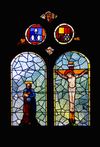
Local lore says the village’s Notre-Dame-de-la-Tronchaye was built on the very site where, in the 12th century, a young sheep herder found a carving of the Madonna and Child in the hollow of a tree. True or not, the church is beautiful, especially in winter when it’s illuminated by dozens of artificial twig trees. It’s usually colder inside than out, but the stained-glass windows, glowing against the white lights outside, make it feel cozy anyway.
Exploring the upper village
Near the top of the village, one popular storefront always draws the crowds: Librairie Sainte-Hortense. Unlike the church, it’s reliably warm inside, with crowded shelves piled high and stacks of books reaching the ceiling. Naturally, Maïwenn goes straight for the newest edition of Asterix, the comic every French kid grows up on. It goes into our bag already heavy with gingerbread and pralines as we head toward the town’s famous castle.
At Christmas, the streets of Rochefort-en-Terre’s upper village are filled with the scent of mulled wine, usually served with orange and cloves from makeshift wooden booths. But on this night, I need to drive—and have a small, gloved hand to keep hold of—so we keep moving toward the castle. We also decide to skip the Naïa Museum, despite its creative decorations, as the museum dedicated to fantasy and sci-fi-inspired art can be a bit too frightening for younger children.
The scent of crêpes and mulled wine thins with each step until we reach the dirt path through the trees.
Instead, we enter the castle grounds. The building isn’t illuminated like the church during the Christmas celebrations, but after nine centuries and plenty of drama, it’s earned the right to stay quiet. Since its construction in the 12th century, it’s undergone several demolitions, a fire and a pillaging that left it in ruins by the late 1700s. What stands now is the work of Alfred Klots, an American painter who bought it in 1907 and restored it to its original grandeur. He’s also the reason the village fills with flowers each spring, as he started the window-box competition in 1911 still running today.
The village owns the castle now, and it keeps the grounds busy even when the building itself is closed. In honor of Christmas, the village adds a carousel for the little ones and wooden booths with garland-draped roofs, from which vendors sell sweet treats and hot drinks. But we’d had our fill of both earlier, so we beeline straight for the carousel. Fantastic as the handmade treats always are, watching the kids squeal in delight as the horses rotate is always the highlight of my trip.
By half past seven, the streets are filling, the crowd packed tight between the strings of lights and smooth stone facades polished by time. It’s time to leave, and the scent of crêpes and mulled wine thins with each step until we reach the dirt path through the trees. Maïwenn and I are planning an early evening, but the village keeps glowing behind us, just as it does every December during the holidays. Though we have a dark drive home in front of us, we have plenty of pralines to snack on during the ride—and knew we’d be back the next weekend, anyway.

Places to stay
Vannes, France

Go further with the Expedia app
