
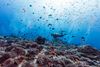
Six dive trips worth planning your year around
The Maldives, Raja Ampat, Palau, Hawai'i's Big Island, Baja California Sur, and Cozumel — six dive trips where seasonal windows, currents, and species set the itinerary.
The first time I dropped into the current at Palau’s Blue Corner and sank below the surface, I was both elated and humbled to get to temporarily become part of one of the liveliest underwater scenes in the South Pacific. I attached my reef hook to the wall, felt the gentle tug that means it is secure, and looked up to find grey reef sharks drifting in slow arcs along the perimeter. Between them, schools of barracuda moved with the current, and even the giant manta with a wingspan longer than your average diver glided along the reef’s edge, rolling side to side and briefly revealing the pale “smiley face” markings on their bellies.
That feeling—of slipping into a world that does not stop for you, but where you’re welcome to spectate—is what separates a dive trip from a beach vacation. Every destination below is a place where you can chase the natural world in its most vibrant state, whether you’re hoping to catch the artful movements of a rare Spanish dancer nudibranch or trying to spot a camouflaged octopus revealing itself on the coral.
The Maldives: where the dive begins at the dock
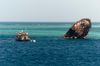
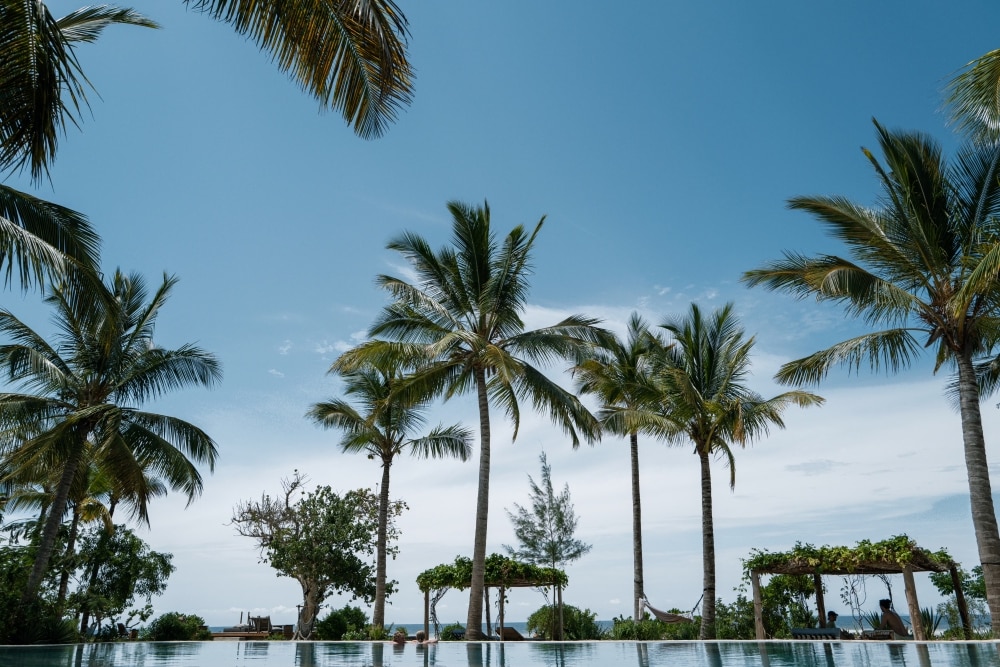
The Maldives is one of those rare places where the infrastructure above the ground is almost as impressive as what’s below the surface. I first dove in the Maldives from the shores of a luxury bungalow resort, with staff who happily escorted us into the water to put on our fins, even with years of dive experience under our belts.
Of the country’s roughly 1,200 islands, nearly 200 are inhabited. Many, like Gili Lankanfushi or Dhidhoofinolhu Island, have their own house reefs with clear water and easy shore access – both so beautiful they would be the headline dive almost anywhere else in the world. On a Maldives dive trip, you’ll roll out of bed, gear up at the island dock, and gently float right off the shore to admire Napoleon wrasse and resident nurse sharks before most people on the island have even had their coffee. However, a perk of the many islands that do offer shore diving is that you can dive at your leisure, rather than being at the mercy of boat schedules.
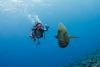
For experienced divers, someboat-accessible sites offer varied pelagic life that can be hard to find elsewhere in the world. This is usually credited to the country’s atolls, with channels between them that funnel nutrient water close to shore. Everything from whale sharks and manta rays to hammerheads and giant yellowfin tuna is drawn to these currents.
Fuvahmulah to the south is known for year-round tiger shark encounters, while the South Ari Atoll attracts massive spotted whale sharks almost year-round. Visibility of nearly 100 feet is extremely common.
Raja Ampat, Indonesia: Where biodiversity is king
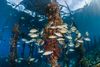
Raja Ampat, an archipelago in West Papua at the heart of the Pacific Ocean’s Coral Triangle, holds a distinction that marine biologists still find difficult to fully explain: it has more recorded fish and coral species than anywhere else on Earth. Here, it is possible to find more than 1,500 fish species and roughly 600 coral species in a relatively small geographic area. It is not unusual to break personal records for the number of species counted in a single dive at sites like Sardine Reef or Cape Kri–and that’s even true for guides who have dived them a thousand times.
In Raja Ampat, soft corals can grow to the size of a large truck, with gold and purple sea fans branching several meters across, and barrel sponges wide enough to sit inside. (Don’t do this, tempting as it may be.) Visibility can be variable in popular sites in the Dampier Strait, but the sheer amount of life means it barely matters–there’s plenty to see in the water at close range.
On Raja Ampat dive trips, most divers base themselves at small island homestays or liveaboards that thread through the archipelago, usually leaving from the gateway city of Sorong. While the karst formations in the north make for lovely above-the-water photos, most serious divers favor the south. That’s where you’ll find the shallow reefs of Misool, where long-enacted fishing restrictions mean marine life has almost no fear of divers. Diving in Raja Ampat is best between October and April, when calm seas make it easier to access the outermost islands.
Palau: Big animals and epic wrecks
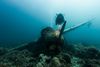
Palau is where you go when you want to feel small. The country’s marine protected areas, including the world’s first shark sanctuary, have allowed populations of gray reef sharks, whitetips, and silvertips to rebuild population sizes that seem almost prehistoric. Blue Corner is the signature site for its circling sharks that seem to never take a day off, though the relatively shallow (by Palau standards) German Channel is one of the few spots I jumped in the water multiple times. On each dive, we were rewarded with at least half a dozen giant manta sightings, sometimes coming within an arm’s reach as tiny wrasse cleaned algae off their bellies.
Of course, Palau’s inner channel offers some of the world’s best WWII wreck diving, accessible via boat rides no longer than 10 minutes, and Jellyfish Lake is one of the few places in the world to swim with stinger-free golden jellyfish. While it is possible to dive the closer sites from hotels around Koror, most serious divers will want to spend at least a few days on a liveaboard to reach remote sites at dawn, when some species are most active.
Big Island of Hawai’i: For divers traveling with non-divers
Most divers underestimate Hawai’i, associating it with snorkeling at crowded Hanauma Bay. My husband did his initial “Discover Scuba” dive in Hawai’i, and I knew after 30 minutes of swimming through ancient lava tubes and admiring sea turtles, he’d be hooked–and he was.
The Big Island is known for manta ray night dives off Keauhou Bay. After dark, you’ll hover near the ocean floor as mantas with up to 15-foot wingspans carve barrel rolls through the dark water, attracted to dive lights hanging below the boat. They get so close that you can often hear the soft whoosh of water moving through their gill plates. It does not get old.
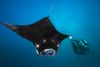
But that’s not the only selling point for the Big Island, and its dives also offer mazes through lava tubes and reliably warm and clear water. You’ll find species unique to Hawai’i, such as Hawaiian cleaner wrasse and the endemic bandit angelfish. If you need even more selling points, it is reasonably close for North American divers and has an above-water culture of coffee farms, farm-to-table dining and volcanic hiking that’ll appeal to non-divers in your group, too.
Baja California Sur, Mexico: What sea lion dreams are made of
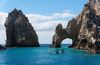
The Sea of Cortez is what Jacques Cousteau called “the world’s aquarium,” and the waters around La Paz and Cabo Pulmo still earn the description. For North American divers who don’t want a long-haul flight to reach pelagic marine life, Baja California Sur is the answer. Cabo Pulmo is a national park and protects the oldest coral reef on the west coast of North America, estimated at 20,000 years old, with seasonal bull sharks and jacks by the thousands that school around massive underwater pinnacles.
For most travelers, La Paz is the jumping-off point to reach seasonal whale shark encounters in El Mogote and the sea lion colony dives at Los Islotes, where playful sea lion pups nibbled on my fins and dive computer the same way a teething puppy would greet a new friend.
Fortunately, the logistics are easy. The quick drive to La Paz from the major international airport in Los Cabos rarely has traffic, and both restaurants and hotels along La Paz’s Malecón are comfortable and reasonably priced.
Cozumel, Mexico: Drift diving that feels like flying through the ocean
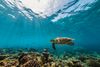
Cozumel doesn’t have whale sharks, manta aggregations, or record-breaking biodiversity. But what it does have is very fast, very fun currents running along one of the healthiest sections of the Mesoamerican Barrier Reef (the second-largest coral reef in the world). That current makes drift diving feel effortless in a way that drift diving elsewhere rarely does. You’ll drop in at Palancar Caves, and once you move into the current, you’ll half-fly, half-swim through coral formations covered in life, above a swatch of sand dotted by tiny green garden eels, and next to everything from spotted eagle rays to hawksbill sea turtles. You’ll consume much less air than normal, and doing three or four dives a day is a regular occurrence here.
Staying further south on the island will mean being a little further from restaurants and nightlife in San Miguel, but it’ll mean you’re no more than 5 to 10 minutes by boat from the best dive sites. However, divers who prefer slightly more unique dives need not miss out, as there’s a daily ferry service from Cozumel to the mainland. We took an early morning ferry to Playa del Carmen and met a dive guide who brought us south into the jungle around Tulum, allowing us to dive the turquoise, cavern-like sinkholes known as cenotes–a once-in-a-lifetime experience you won’t find on this scale anywhere else in the world.

Suzie Dundas is a Tahoe-based travel writer, editor, and author whose work focuses on travel, the outdoors, and public lands. A former political staffer turned treehugger, she’s written for Outside, AFAR, SFGate, BBC, Thrillist, and Lonely Planet, among others. She’s currently the commissioning editor at Matador Network.
Places to stay
Maldives

Go further with the Expedia app
