
Crete through food, ruins, and ritual
In Europe’s 2026 Region of Gastronomy, Crete unfolds through food markets, ingredient-led meals, ancient ruins, and nights filled with music.
Greek islands have a way of pulling you in. Among Greece’s 200 inhabited islands, Crete stands apart for both its size and personality. It’s the largest island in Greece, stretching roughly 160 miles from east to west, with mountain ranges, beaches, olive groves, and archaeological sites that make it feel like a world of its own.
What makes Crete memorable isn’t just the checklist of beaches and layers of history through Minoan, Venetian, and Ottoman influences. As Agapi Sbokou, co-CEO of the luxury Greek hospitality brand PHĀEA and Vice President of the Greek Tourism Confederation, puts it, the island is best understood through the way its landscapes, food traditions, and daily rituals connect to one another. A morning might begin at an ancient palace, drift into a long lunch of local foods, and end in a village square filled with music.
Taste the 2026 European Region of Gastronomy

You’ll find a deep understanding of Crete through the food. “Cretan cuisine is defined by purity, patience, and respect for the land,” Sbokou says, noting that while the list of local ingredients is not overly long, each is deeply meaningful—think wild greens and mountain herbs, fresh seafood, ripe vegetables, handmade goat cheese, slow-fermented sourdough, and, most importantly, extra virgin olive oil.
That last ingredient deserves its own pause. Crete is responsible for about a third of the total olive oil produced in Greece. “Olive oil is the foundation of our diet and rituals,” Sbokou says. A drizzle of fresh oil and a pinch of salt over warm bread or a sliced tomato can feel as complete as any composed dish. She adds that Cretan cuisine can show you how luxury can mean simplicity, from waiting for dough to rise naturally to gathering seasonal vegetables at peak flavor.
That ethos feels especially relevant now: Crete is the European Region of Gastronomy for 2026, a recognition that frames the island’s food culture as a living expression of history, biodiversity, and hospitality. The designation highlights the Cretan diet as a cornerstone of the Mediterranean tradition and emphasizes that the island’s table is as much about sharing relationships and ideas as it is about ingredients.
Head to the markets to taste Crete’s food culture for yourself. In western Crete, the Chania Municipal Market is one of the island’s best-known places to browse stalls filled with herbs, cheeses, olive oil, honey, greens, fish, and produce. In eastern Crete, the Wednesday open-air market in Agios Nikolaos brings in local producers with fresh vegetables, fruit, and dairy. You’ll find a Cretan meal that’s led by ingredients first at Ntounias in the hills outside Chania, while farther east, you’ll find PHĀEA’s Blue Door Taverna for traditional recipes in a waterfront setting.
See Crete’s ancient Minoan history
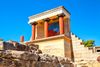
To understand Crete, Sbokou says, you have to start with the Minoans—their civilization gave rise to one of the earliest literate, urban societies in Europe. You can still feel that ancient influence today at sites like Knossos, the largest Bronze Age archaeological site on the island. Sbokou emphasizes that its association with the myth of the Minotaur is important, but so is how the forward-thinking architecture built in Knossos thousands of years ago speaks to craftsmanship, ceremony, and innovation.
At the Archaeological Museum of Heraklion, you can see the enigmatic Phaistos Disc, one of the earliest known examples of stamped writing in the ancient world that was found at the Minoan palace of Phaistos. “Though still undeciphered,” she says, “it testifies to the intellectual sophistication of the Minoans and their early experimentation with systems of communication and symbolic language.” The Minoan Palace of Malia offers something different. Known for its massive ceramic storage containers called pithoi, the site points to the scale of the island’s economic life, and because it remains less reconstructed than Knossos, you can experience what Sbokou describes as a more “raw” archaeological experience.
End your journey through Minoan history at Zakros. “Zakros offers a clearer snapshot of palace life at the moment of its destruction,” Sbokou says. All four of these Minoan palace sites—Knossos, Malia, Phaistos, and Zakros—are on UNESCO’s World Heritage List, along with Zominthos and Kydonia. “Together, these six palaces reflect a civilization of remarkable diversity and ambition,” she says, as their collective nature speaks to the universal value and Crete’s enduring legacy of openness, craftsmanship, and cultural exchange.
Relax on the beach and end with a night of music

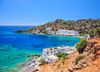
After mornings spent among palace ruins and market stalls, a well-rounded trip to Crete must also include the coast. Go to Voulisma for a beach day that feels connected to the island’s wilder side. Here, Sbokou says, “the fine white sand and lush green surroundings give the sea a turquoise hue that feels almost cinematic.” In high summer, she notes, locals often slip away to the nearby pebbled cove of Chartalami for a quieter swim.
End your trip on a note that feels distinctly Cretan. Sbokou suggests panigiria, rather than conventional nightlife. “These summer festivals, rooted in faith, harvest, and community, are the beating heart of island life,” she says. Nearly every village hosts its own celebration, and circles of dancers, improvised mandinades, and musicians playing the lyra and laouto will draw you into a communal local rhythm. “In Crete, music rises from community; it is the sound of togetherness, spontaneous, heartfelt, and deeply rooted in place,” she says. That spirit carries into Sbokou’s broader view of the island. “Community is the heart of Cretan life,” she says, describing a culture shaped by kefi—a generous, joyful conviviality found in shared meals, shared songs, and evenings that stretch naturally past sunset. “To switch off the Cretan way is not to disconnect; it is to reconnect with land, with memory, and with one another.”

Vicki Denig is a wine, spirits, and travel writer based between New York and Paris. Her writing has appeared in Food & Wine, Decanter, Condé Nast Traveler, and Resy. Upon landing in a new destination, her first order of business is finding a local bar, preferably outdoors, and people watching with a drink in hand.
Places to stay
Crete

Go further with the Expedia app
