
Oaxaca, between the metate and the street
Tracing the maize, mole, and lineage of cooks that make Oaxaca one of the world's great food destinations.
The wall of marigolds hanging in Noemí López Hernández’s courtyard kitchen in Oaxaca had been up since Día de los Muertos. They were dry now, nearly a month later, but the color was still vibrant. A goat bleated somewhere beyond the courtyard. In front of me, the morning’s ingredients of maize, plantains, tomatoes, garlic, three kinds of chiles, and sun-warmed chayote squash sat in clay bowls and woven baskets.
Mimi, as she insisted I call her, greeted me in a hot pink dress with fringe at the hem and a blue apron embroidered with flowers and a butterfly on each shoulder, hair pulled tight into a bun. Short enough that her head didn’t reach my shoulder, she moved with the easy authority of someone who had run a kitchen her whole life. In Spanish , which her son Charlie translated when she paused long enough, she quickly ran down the list of traditional regional dishes we’d be making together.

The first task was a salsa made with garlic, tomato, onion, and dried chiles ground by hand in a molcajete small enough to hold in one palm. Six other travelers had stations of their own. A fire had started under the comal, pushing wood smoke from the outdoor ovens into the November air. It was warm enough outside to bring a sweat over the molcajete, and warmer still as the fragrant chiles for the day’s mole negro began cooking in a heavy pot.
“Cooking is about the ingredients,” Mimi said, working alongside me, “but also about who is making your food. There should be joy in the kitchen. You can taste when the food is made in a bad mood.”
The ingredients in the Cradle of Mexican Cuisine
I have eaten across Mexico — coastal Zihuatanejo and Baja, the Yucatán, repeated trips through Mexico City — and Oaxaca’s cuisine is notably distinct. The state has 16 Indigenous groups (more than any other Mexican state) and 570 municipalities across mountains, high desert, valleys, and a long Pacific coast. One could spend a lifetime on mole alone. The chilhuacle chile, sweet with notes of dried fruit, grows here and nowhere else. So does the pasilla oaxaqueña, smoke-cured over wood. Heirloom maize varieties have been bred over thousands of years for soils and altitudes that exist only on these slopes. Sinmaíz, no haypaís , the saying goes — without corn, there is no country.
Mimi’s courtyard sits in the central valleys that fan out of the state capital, Oaxaca de Juárez — the center of the mezcal bars and chef-led dining rooms, and where the main food markets sit. The mountains and coast have their own twists based on what’s available. “The diversity of our ingredients plays an important role in differentiating us from the rest of the country,” Lorena Rubio, a Oaxaca de Juárez native and the owner of Oaxaca Eats Food Tours, once told me. “Each region has its own.”
From ingredient to dish
My first stop upon arrival was Mercado 20 de Noviembre. A woman near the entrance scooped a bag of chapulines for me from a wide woven basket, and I bought a glass of tejate—the pre-Hispanic cacao and corn drink mixed and made foamy by hand. Walking deeper in, I passed through the pasillo de humo, a narrow corridor of woodsmoke and grilled meat where slabs of beef hung from hooks that cooks pulled down to order. I kept walking, past the smoke, until I reached the tlayuda stalls at the back. The flat, crisp tortilla topped with beans, stringy quesillo, avocado, and chorizo was the size of a medium pizza and came with mezcal from a plastic water bottle and a small plate of the agave-worm salt, sal degusano, thataccompanies most pours.
Three iconic Oaxacan dishes
Mole
The seven traditional moles are the framework: negro, rojo, amarillo, verde, chichilo, manchamantel, and coloradito. Most cooks keep a personal version that doesn’t sit cleanly in any category. Mole negro is the deepest and most labor-intensive, simmered for hours with dozens of ingredients and served over chicken or turkey; amarillo and coloradito turn up in everyday cooking.
Tlayuda
A crisp tortilla close to a foot across, spread with asiento (rendered pork fat) and refried black beans, then layered with quesillo, avocado, and meat — usually tasajo, cecina, or chorizo. Best at street stalls and market grills after dark, sold open or folded.
Memelas
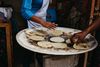
Small, oval, hand-shaped masa cakes pressed flat on a comal and topped with asiento, refried beans, salsa, and quesillo. The default breakfast across the state, sold from market stalls and street carts hours before many restaurants open.
For all that Oaxaca has to offer, mole is among the most famous. The seven traditional moles in the state are starting points. Each cook has their own twists passed over generations. Mole negro, built from dozens of ingredients, is often considered the most complex. The chiles—chilhuacle negro, mulato, and ancho—are charred over open flame, and nuts, fruit, and spices are folded into a sauce that simmers for hours to build flavor.
At Mimi’s, the work happens with tools used in Oaxaca for thousands of years. A molcajete grinds the small ingredients, while a metate, a long stone with three legs and a rolling-pin-like mano to push across it, does the same thing on a bigger scale. I got on my knees to push the mano over dried corn to the soundtrack of stone scraping stone. Ten minutes in, my core was burning. Mimi came over with notes: “You are too soft. Put muscle into it.“

At the next metate, I worked the mole ingredients and pushed oils out of nuts in a pleasant haze of dried chile dust. “You can do this with a machine,” Mimi said. “It would not taste like this.”
No bad meals
The cultural backbone of Oaxacan cooking is the cocineras tradicionales — the women who carry recipes through families and home kitchens. The same lineage feeds the city’s cocina deautor fine dining scene. At Casa Oaxaca, dinner began at sunset on a rooftop with crisp purple-corn tortillas with lightly seasoned avocado, cold local beer, and tacos filled with grilled quesillo, slow-simmered goat, avocado salsa, and cilantro. A brass band played somewhere below. At Las Quince Letras, a refined mole negro arrived alongside stuffed chayote, the sauce dark and rich like those I had from cooks who learned to make it at home first.
At one in the morning outside Mercado Benito Juárez, I found a trailer selling pozole. Locals filled the stools around the cook — construction crews still in their work clothes alongside men in business jackets — and I took a metal stool at a makeshift table behind them. The bowl came thick with pork and radishes, shredded cabbage and lime on the side, and a large, dried tortilla for scooping. Two rolled tacos of slow-cooked chicken came with it, dressed with habanero salsa. The heritage corn and complex broth served from that trailer were among the most flavorful I ate on the trip.
"Oaxacan gastronomy is at the level of the best kitchens in the world."
Rubio was born and raised in Oaxaca de Juárez and has seen the type of travelers arriving in the city change. “Understanding the ingredients, the origin of each one, the hands behind them, and the time invested in each dish is a very different way of appreciating our gastronomy,” she says. With culinary tourism on the rise, travelers now arrive in Oaxaca with food as the reason for the trip, not just part of it. Even those who don’t know Mexican cuisine well tend to understand how a plate ties back to the land and the people behind it.
Many travelers routed through Mexico City to get here. Oaxaca International has direct service from a handful of U.S. cities, but the connection through CDMX is easier to find. I went in November, near the start of the dry season that runs through April and when the markets and harvests are at full strength. I barely touched my rental car in the city — the cobblestones are old, the lanes feel optional, and almost everything a food traveler wants is reachable on foot in the historic center. Local tour shuttles can take you elsewhere, like the short sprinter van ride I took to Mimi’s house in Matadamas.

We sat down to eat as the last tortillas came off the comal. The mole, hours in the making, was ladled over chicken legs; the salsas, tamales, rice, stuffed chayotes, and small bowls of chayote stew were already on the table. In front of every plate was a small pour of Mimi’s mezcal in a glass with a cross on the bottom, and a glass of fresh citrus juice alongside it. We ate slowly. Afterward, in the late-afternoon light, I took a photo with Mimi in front of the wall of marigolds. I left with a bag of mixed dried spices tied at the top, a notebook full of half-recipes, and a better technique for tortillas and tamales. The chiles have proven as hard to find outside of Oaxaca as promised, and I still leave mole to the experts. What stays is the way Mimi taught the work: by taste and feel, no measurements. One trip is not enough.

Nickolaus Hines is an award-winning writer and editer based in Denver. He has written for Thrillist, InsideHook, Men’s Journal, Food & Wine, Wine Enthusiast, 5280, and more. He is the editorial content director at Matador Network.
Places to stay
Oaxaca


Go further with the Expedia app
