

Between two Christmases: A yuletide journey through Tbilisi
While the rest of Europe packs away its lights, Georgia's capital is just getting to its second Christmas — a season shaped by an older calendar, an older church, and a country that never fully gave up either.
By mid-January, most of the world has packed away its lights. In Tbilisi, Christmas hasn’t happened yet. The Georgian capital follows the Julian calendar its Orthodox Church has kept since the fourth century, so Rustaveli Avenue’s illuminations stay lit, the markets stay open, and children keep waiting for Tovlis Babua, the Snow Grandfather, to make his way down from the Caucasus — almost three weeks after the rest of Europe has moved on. Children wait patiently for Tovlis Babua to complete his circuit from the snowy heights of Georgia’s Caucasus Mountains. Rustaveli Avenue’s giant illuminations and festive markets remain intact until after the ceremonial burning of Chichilaki trees, almost three weeks into the New Year. There’s no better place to get the most out of your Yuletide spirit because here, you can stretch it into late January.
Tbilisi: A city between calendars
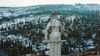
At any time of year, Tbilisi feels suspended between Europe and Asia. Ask locals which continent they consider home and some may even insist that Georgia, or Sakartvelo, is a continent in itself. Here, golden church domes rise above weathered Soviet blocks, Art Nouveau mansions overlook Persian courtyards and ancient Orthodox traditions influence daily life. A 20-meter-tall sculpture of Kartlis Deda, Mother of Georgia, watches over this tangle of history, bearing a sword to deter enemies and a cup of wine to greet guests.
Besides being the oldest winemaking nation, Georgia is one of the world’s oldest Christian nations. The Kingdom of Iberia adopted the religion in the 4th century AD, a few centuries before merging with the Kingdom of Colchis to become a united Georgia. Tbilisi’s high concentration of Georgian Orthodox churches (approximately 200) and its commitment to the Julian calendar reflect the country’s stance on tradition and liturgical rhythm.
Being a country which likes to do things differently, most Tbilisians choose to celebrate Christmas on a different day than much of the western world. As such, Christmas in Tbilisi is celebrated on January 7, with “Old” New Year following on January 14. Epiphany, falling on January 19, concludes the festive season. December 25 passes as an ordinary day here, as restaurants seat their usual dinner crowds and museums keep normal hours, because the calendar that governs the season doesn’t start counting until January. The calendar isn’t just about dates, however. It’s one of the last things Georgia never fully surrendered — not to the Persians, not to the Russians, not to the Soviets.
Christmas in the streets and skies

The Alilo procession is the centerpiece of Tbilisi’s Julian Christmas. Thousands of people don white clothing or Nativity garments and follow the clergy through the streets of Tbilisi, singing hymns polyphonically. The carols sung along the route belong to Georgian polyphonic singing, a tradition inscribed on UNESCO’s Intangible Cultural Heritage list since 2001, specifically covering multiple independent vocal lines sung without instruments, a style that survived Soviet-era restrictions on religious music.
As they march, participants gather donations of food and gifts, which are later distributed to charities and families in need. Travelers are welcome to spectate from the sidelines, or even tag along. Leaving First Republic Square, the route sweeps along Rustaveli Avenue before crossing Baratashvili Bridge and concluding at the Holy Trinity Cathedral, a defining emblem of Tbilisi’s skyline. The path is paved with a canopy of artificial stars and passes the annual boulevard of holiday illuminations, linked by a theme that changes each year.
Despite Tbilisi observing two Christmases (travelers will find restaurant specials and midnight masses on December 24 and 25), most families reserve December 31 for their yuletide feast and the exchange of gifts. A gala typically takes place late at night in First Republic Square, followed by an evening of amateur pyromania as Tbilisians take to the streets, blasting fireworks until the early hours in lieu of a coordinated spectacle.
The tree that came first
Long before the evergreen arrived in Georgia, there was the chichilaki. Shaved from hazelnut or walnut branches into curled, beard-like strands, the tree existed in Georgian homes before anyone here had heard of a fir dressed in tinsel. Dressed simply with dried fruit and a few sprigs, it symbolizes renewal, and it’s burned the night before Epiphany, taking whatever went wrong the previous year with it. That the chichilaki still stands in windows next to imported evergreens, rather than having been replaced by them, says something about how Georgia tends to absorb outside influence without letting go of what came first, and this is the same instinct that kept the Julian calendar in place while the rest of the continent moved on.
Tovlis Babua, the Snow Grandfather who brings the gifts, keeps to that same older logic. He doesn’t work on a fixed December 25 schedule; some children get their presents on December 31, others wait until January 7.
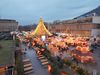
The markets that spring up around the season bridge the timelines. Tbilisi’s Christmas Village runs at Orbeliani Square and First Republic Square from early December into mid-January — long enough to serve Western Christmas, Georgian New Year, and Orthodox Christmas without ever closing between them. Dedaena Park hosts a weekend food-and-wine market, and Fabrika’s courtyard fills with an arts and crafts fair just ahead of December 25, selling handmade decorations, toys, jewelry, and sweets. A lurji supra, the woven Georgian tablecloth, travels better than most souvenirs and carries more of the country’s table culture in it than anything else sold at these stalls.
Supra: The tablecloth tells the story

There’s plenty of merriment on the streets, but any Georgian celebration ultimately plays out around the table. As the supra is laid out (the term is used interchangeably for tablecloth and feast), tables bend beneath platters of rich khachapuri (cheese-filled bread, often kneaded into the shape of a canoe), fragrant pkhali (vegetable and herb-based pâté) studded with pomegranate seeds, walnut-rich stews, and khinkali soup dumplings bursting with minced meat, mushrooms or cheese.
Whether at a private supra event or restaurant, food is served not to impress, but to welcome — after all, in Georgia, every guest is considered a gift from God. Homemade wine flows from clay qvevri vessels, with the tamada (toastmaster and supra host) ensuring no glass runs dry. Besides earthy gulps of Saperavi, expect splashings of chacha, a potent brandy distilled from pomace during the winemaking process.
Gozinaki, a confectionery of walnuts and honey, is the signature festive specialty. This brittle is carved into diamond shapes and eaten abundantly throughout the holiday season, with its sweetness representing prosperity. Baked at home in every household, it’s widely available at festive markets and easy to transport home.
Bedoba: a day that decides the year
New Year’s Eve, not December 25, is when Tbilisi actually exchanges gifts — a gala in First Republic Square, then fireworks lit by hand rather than choreographed, filling the streets until morning. The market pause lasts exactly one day. By January 2, Georgians are back out for Bedoba, the Day of Luck, when however the day goes is believed to set the tone for the next twelve months. Locals lean into it harder than any other day on the calendar, pulling visitors into a toast or pressing a coin into their palm for nothing in return. It’s the same instinct that runs through the whole season here: a ritual older than any imported holiday, still setting the terms for how the modern one gets celebrated. The Dry Bridge Market, Tbilisi’s flea market for Soviet-era relics and vintage decorations, reopens the same day and is worth combing through once the luck has been sorted out.
The baths beneath the city
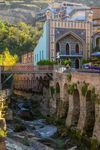
Tbilisi means “warm place,” named for the sulfur springs that gave the city its start under King Vakhtang Gorgasali, according to the founding legend. The baths built over those springs in Abanotubani have outlasted every calendar the city has run on. Some of the current domes date to the Persian period, when the district functioned as a small city of its own, ringed by caravanserais and markets. Pushkin soaked here in 1829 and called it the most luxurious bath he’d taken in Russia or Turkey; Dumas came through decades later and left just as impressed. Empires have moved through Tbilisi and out again — Persian, Russian, Soviet — but the ritual underneath Abanotubani hasn’t changed: a soak in sulfur water, a scrub with a kisa mitt, a slow morning that owes nothing to whichever power happened to be governing the city at the time.Whatever the budget, the ritual hasn’t changed: a soak, a kisa scrub, and a reason to slow down on a cold day.
Snow rarely settles over Tbilisi itself, though the hills ringing the city may catch a dusting by late December. The real snow, the kind that makes Tovlis Babua’s journey believable, waits in the Caucasus proper. The peaks above Stepantsminda, where he’s said to keep his home, and the slopes around Gudauri and Bakuriani, both a few hours from the city along the Georgian Military Highway. It’s the same range that’s shown up on Georgian coins, currency, and folklore for centuries: mountains that have functioned less as scenery than as a border the country has always measured itself against.
The charitable parade, combined with the auspicious hunt for luck on Bedoba and the wine that never stops pouring is what happens when a country runs holiday celebrations on its own terms While the rest of the continent has already put its lights away, Tbilisi is still deciding, on its own schedule, when the season ends.

Places to stay
Tbilisi

Go further with the Expedia app
